Everything in space, where it is right now.
Astraeus does the hard part of space on the web: time, orbits, reference frames and astronomical scale. Every body answers one question, where are you at this moment, and every answer says where it came from. You bring the story.
// Where was the Moon when Eagle landed?
moon.stateAt(Date.parse("1969-07-20T20:17:40Z"), "earth")

{
  frame:      "EQJ",      // J2000 equatorial
  center:     "earth",
  positionKm: [-385_000, -48_000, -31_000],
  provenance: {
    sourceType: "ephemeris",
    sources:    ["orb.js lunar series"],
  }
}
// JPL Horizons, same instant: −385,275 · −47,906 · −30,879 km
Four layers, one door in.
A planet, a spacecraft, a comet and twenty-five thousand meteoroids all enter the same way. Everything downstream draws them the same way.
- 01 · STATE
Where and when
Time scales, positions, velocities, orientation and frames, each with its source and accuracy.
- 02 · SOURCES
Plug in the data
Planet theory, NASA mission samples, published orbits, measured meteor catalogues. Swap one without touching the rest.
- 03 · DRAWING
Safe at any scale
True or readable scale, a floating origin so 51 AU stays steady, paths, labels, light and a real star sky.
- 04 · STORY
Time you can play
Timelines, events, focus and follow, story panels that open as playback reaches their moment, and an info panel that shows what's measured and what's filled in.
The shelf, ready to use.
Bodies, sky and data that ship with the engine's demos, each with its source and licence on record.
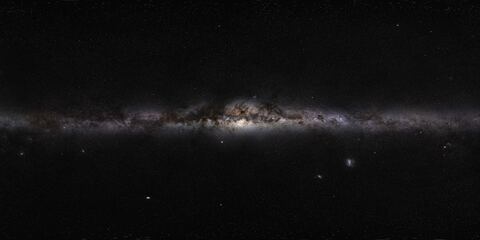
8,920 naked-eye stars from the HYG catalogue, and ESO's panorama in the same frame.
Perseids from 2025, every meteor on its own ellipse. CC BY 4.0.
A comet out to 51 AU, an asteroid from a settings file, and 30 timed Apollo events.
Built with it.
Two stories that couldn't be more different, on the same engine with no special cases. Open Developer mode in either to see what's underneath, or to copy a link to the exact view on screen.
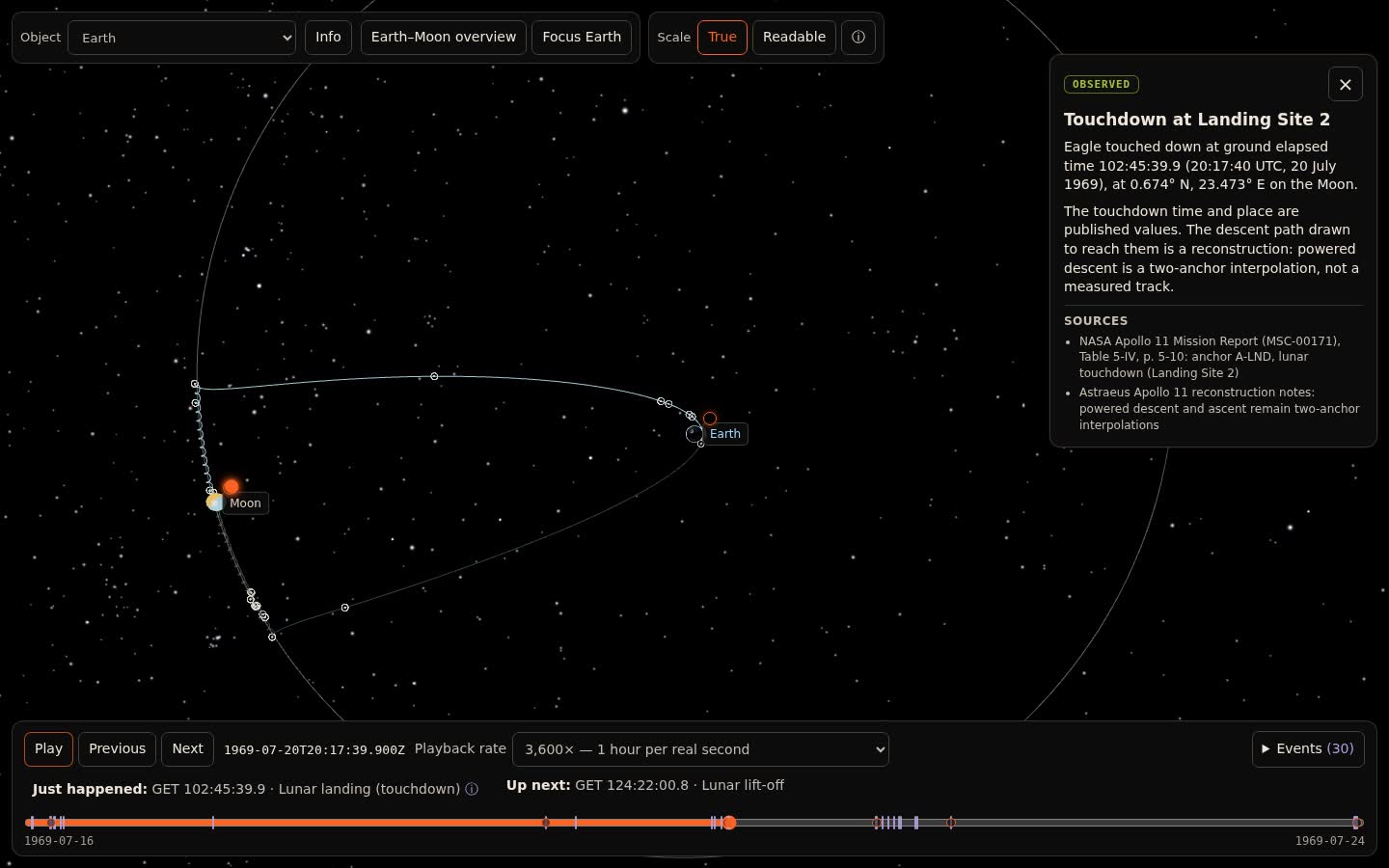
Apollo 11
Eight days to the Moon and back, rebuilt from NASA's mission report. Seven story panels open as the clock reaches each step, from leaving Earth orbit to splashdown, each with its sources.
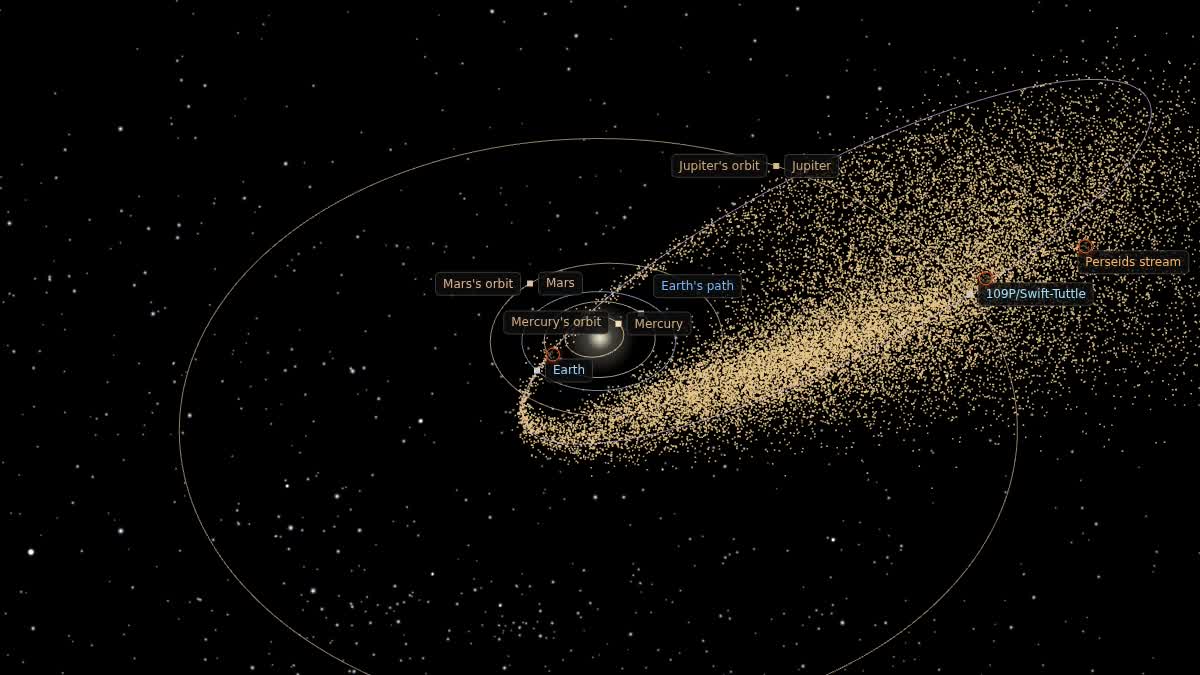
The Perseids
Earth through comet Swift–Tuttle's trail. A whole shower from one settings file. Three story panels say what is measured here and what is filled in.
- 1question every body answers: where are you, now?
- 25,588measured meteor orbits, drawn one by one
- 51AUout to a comet's far end, without losing precision
- 1settings file was all a new shower needed